Quick answer
Yes, mattress toppers really work, but only for comfort problems. A good topper can soften a firm bed, add a little support to a slightly soft one, relieve pressure points, reduce motion transfer and help you sleep cooler. A topper does not work on a mattress that sags, has broken springs or has lost its support. If your mattress is structurally sound, a topper is usually worth it.
Mattress toppers are one of the most popular sleep upgrades, and also one of the most debated. Some people say a topper transformed their sleep; others say theirs flattened in months and changed nothing. Both can be true, because whether a topper “works” depends almost entirely on the problem you’re asking it to solve.
In this article we’ll look at what toppers genuinely do well, the situations where they disappoint, how they compare with buying a new mattress, and a quick way to decide whether one is worth your money.
How a Mattress Topper Works
A topper adds a new comfort layer to the surface of your bed. When you lie down, your body sinks into that layer first, before it reaches the mattress below. Depending on the material, that layer can cushion, contour, push back, breathe or absorb movement.
What a topper doesn’t do is replace the support core of your mattress, the springs or dense foam deep inside that hold your spine in line. The topper rests on top of that core, so it can only ever be as good as the foundation underneath it.
That single fact explains almost every success story and every complaint: toppers are great at changing the feel of a bed and poor at changing its structure.
What Mattress Toppers Do Well
Softening a mattress that’s too firm
This is where toppers shine. A 2 to 3-inch soft memory foam or fiber topper can turn a hard mattress into a comfortable one, especially for side sleepers whose shoulders and hips need room to sink. If you bought a firm mattress and regret it, a topper is often the cheapest fix.
Relieving pressure points
Contouring foams spread your weight across a larger area, which reduces the pressure on bony areas. Many people who wake up with numb arms or achy hips on a firm bed notice a difference within a week.
Adding a little support to a slightly soft bed
A firm latex or high-density foam topper can make a mattress that’s just a bit too soft feel more supportive and easier to move on. Note the word “slightly”: a firm topper can’t stop a sagging mattress from sagging.
Sleeping cooler
Swapping a heat-trapping surface for latex, wool or an open-cell foam topper can make your bed feel cooler. Results vary, but hot sleepers on dense memory foam mattresses often notice an improvement.
Reducing motion transfer
Memory foam absorbs movement, so a topper can help light sleepers who are woken by a restless partner, particularly on a bouncy innerspring mattress.
Extending the life of a mattress
A topper takes much of the daily compression that would otherwise wear down your mattress’s comfort layers. That can keep a good mattress comfortable for longer, and the topper is cheaper to replace than the mattress.
When Mattress Toppers Don’t Work
Most disappointing topper experiences fall into one of these situations:

- The mattress is sagging. The topper sinks into the same dip, often within weeks, and back pain continues.
- The topper is the wrong firmness. A thick, plush topper on a soft mattress can let your hips sink too far, especially for back and stomach sleepers.
- The foam is low-density. Cheap, low-density foam (and many egg-crate toppers) can flatten within a few months of nightly use.
- The expectations are medical. A topper can make a bed more comfortable, but it isn’t a treatment for a back or joint condition.
- It keeps sliding. A topper without straps or grip can shift and bunch, which makes it feel worse than having no topper at all.
Red flag
If you can see a dip of more than about 1.5 inches when you lay a straight edge across your mattress, or you roll toward the middle every night, put your money toward a new mattress or a warranty claim instead of a topper.
Mattress Topper vs New Mattress
A topper costs a fraction of a new mattress, so it’s tempting to try one first. Here’s how to think about the trade-off:
| Topper | New mattress | |
|---|---|---|
| Fixes “too firm” | Very well | Yes |
| Fixes “slightly too soft” | Somewhat | Yes |
| Fixes sagging | No | Yes |
| Cost | Low to moderate | High |
| Effort | Unroll and go | Delivery, setup, old mattress removal |
| Typical lifespan | 1–10 years by material | 7–10 years |
If your mattress is under about six or seven years old and still supportive, a topper is usually the better value. If it’s older, visibly worn or sagging, a topper is a short-term patch at best.
Who Gets the Most Value From a Topper
- Side sleepers on firm mattresses.
- People who bought a mattress that’s firmer than expected and can’t return it.
- Hot sleepers on dense foam mattresses.
- Couples bothered by motion on a springy bed.
- Anyone upgrading a guest bed, dorm bed, sofa bed or RV mattress on a budget.
- Owners of a good, newer mattress who want to protect it from wear.
How to Make Sure Your Topper Works
A few choices make the difference between a topper you love and one you regret:
- Match the material to your problem. Memory foam for pressure relief and softness, latex for support and cooling, fiber for plushness, wool for temperature control.
- Pick sensible thickness. Three inches suits most people; two inches for small tweaks or stomach sleepers; four inches for very firm beds or heavier side sleepers.
- Check density. For memory foam, around 4 lb/ft³ or higher generally lasts longer than lighter foams.
- Look for straps or a fitted cover. A topper that stays put feels better and wears more evenly.
- Read the return policy. Comfort is personal, so a sleep trial or an open-box return option is worth a lot.
- Give it a week. Your body needs time to adjust to any new surface.
Are Mattress Toppers Worth the Money?
For the right bed and the right problem, yes. A well-chosen topper is one of the best-value sleep upgrades you can buy, often delivering a “new bed” feeling for far less than a new mattress. For a sagging or worn-out mattress, no: you’ll spend money and still sleep badly.
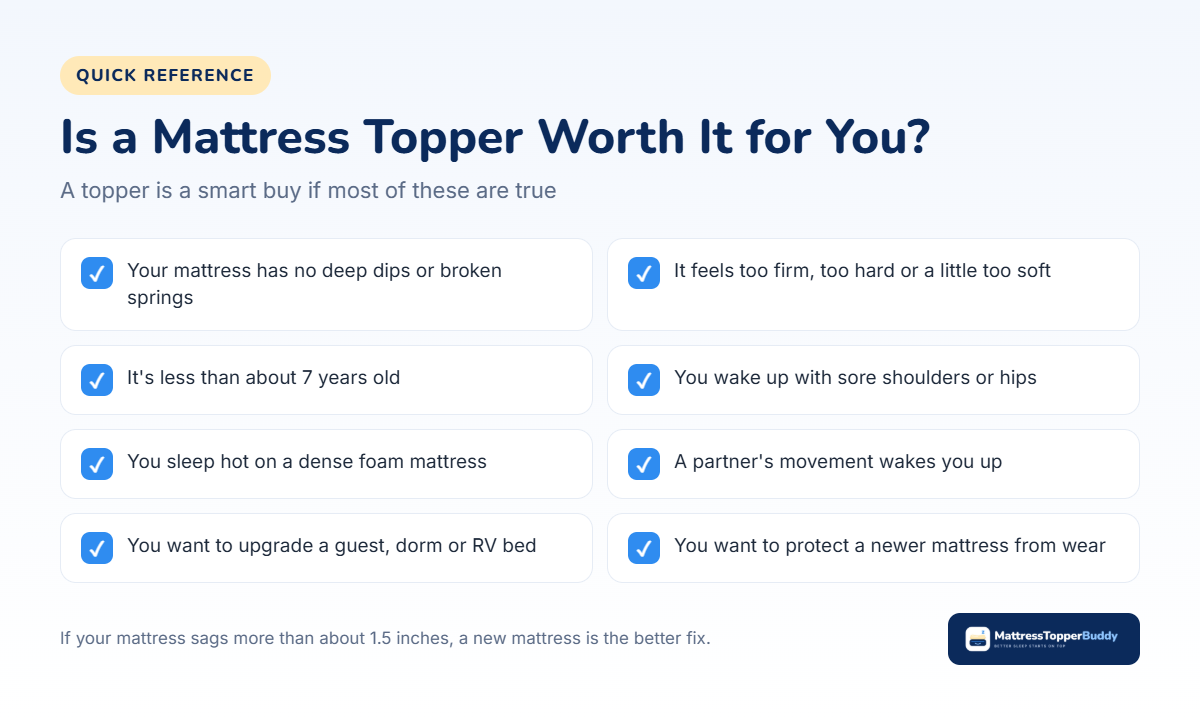
The simplest way to decide is to ask one question: is my mattress still supportive? If the answer is yes, a topper will almost certainly help. If the answer is no, skip the topper and fix the foundation first.
Signs Your Topper Is Working (or Isn’t)
After a week or two on a new topper, check in with yourself honestly. The signs that it’s working are usually easy to spot:
- You fall asleep faster and toss and turn less.
- Morning stiffness or shoulder and hip soreness has eased.
- You wake up less often because you’re too hot or because your partner moved.
- The bed feels evenly comfortable from edge to edge, with no new lumps or slopes.
The signs that it isn’t are just as clear. If you feel like you’re sinking into a hole, wake up with a sore lower back, or notice the topper sliding and bunching every night, something is off. Usually the fix is simple: a firmer or thinner topper for back and stomach sleepers, a softer or thicker one for side sleepers, or better straps and a deeper fitted sheet to keep it in place.
If you’ve tried a well-matched topper and still wake up sore, that’s a strong hint that the mattress underneath has lost its support, and it may be time to look at a replacement rather than another topper. This is also why it pays to buy from a seller with a fair return window: you can test the topper in your own bed and send it back if it’s the wrong fit, instead of being stuck with it.
Frequently Asked Questions
Can a mattress topper help with back pain?
It can help if your pain comes from a mattress that’s too firm or too soft but still supportive. It won’t help much if your mattress is sagging, and it isn’t a medical treatment.
How long does it take to get used to a topper?
Most people adjust within one to two weeks. Give it at least a week before judging.
Is a topper better than a new mattress?
For a supportive mattress that just feels too firm or warm, a topper is better value. For a sagging or worn-out mattress, a new mattress is the better choice.
Why did my topper flatten so quickly?
Usually because it was low-density foam or fiber, or because it was on a mattress that was already sagging.
The Bottom Line
Mattress toppers really do work when they’re used for what they’re designed to do: changing how a supportive mattress feels. Choose the right material, thickness and density, make sure it stays in place, and you can expect a real improvement in comfort. For a step-by-step buying process, see how to choose a mattress topper, and if you’re still unsure what a topper is, start with what is a mattress topper.