
Quick answer
Most mattress toppers last between 1 and 10 years depending on the material. Egg-crate and fiberfill toppers usually last 1–3 years, memory foam 3–5 years, and latex and wool 5–10 years or more. Replace your topper when it keeps a visible body impression, feels flat or lumpy, no longer relieves pressure, or smells musty even after airing out.
A mattress topper is an investment in your sleep, so it’s natural to wonder how long it will actually last. The honest answer is that it depends heavily on what it’s made of, how dense it is, how much weight it supports every night and how well you look after it.
This guide breaks down typical lifespans by material, explains what makes a topper wear out faster, shares simple habits that extend its life, and lists the clear signs that it’s time for a replacement.
Average Lifespan by Topper Material
These ranges assume nightly use by one or two average-weight adults. Lighter use (a guest bed, for example) can stretch them further; heavier use can shorten them.
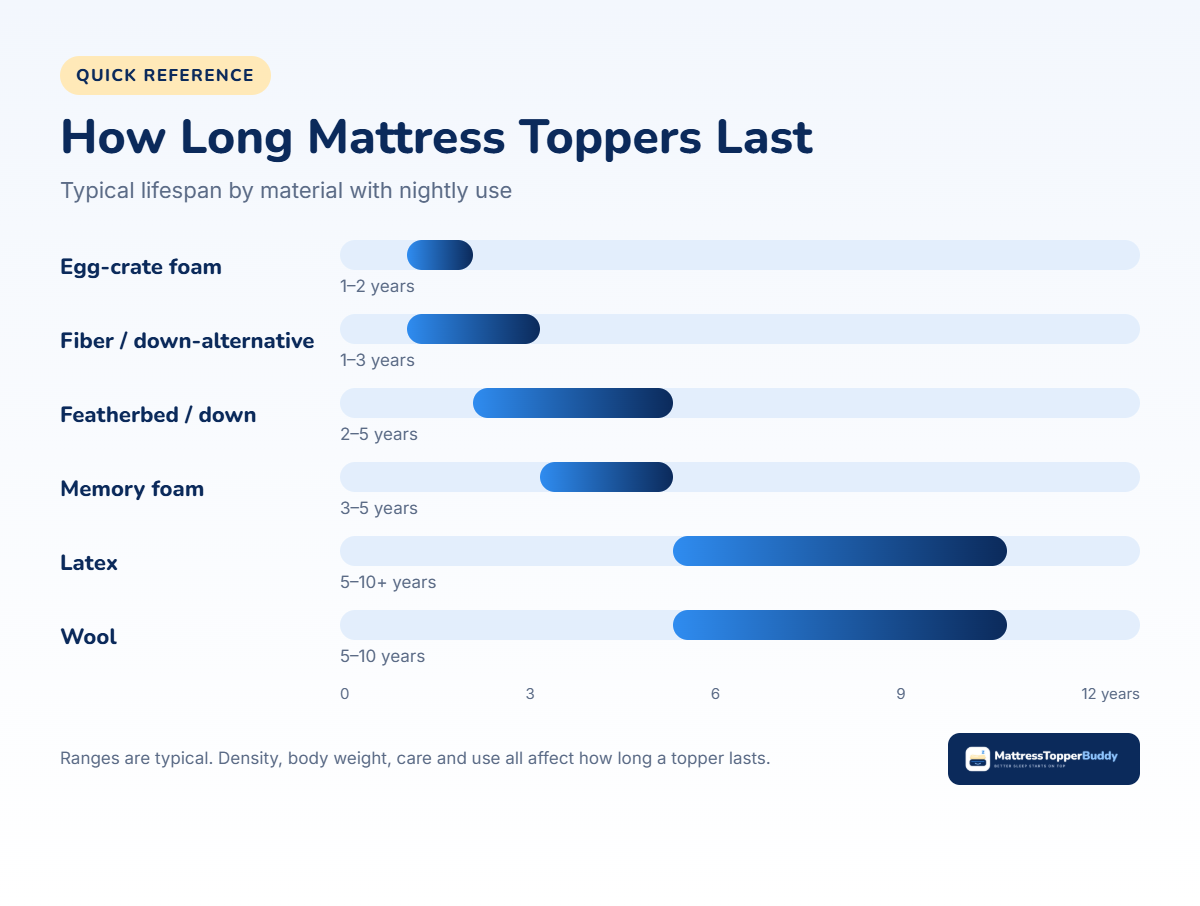
| Material | Typical lifespan | What usually fails first |
|---|---|---|
| Egg-crate (convoluted) foam | 1–2 years | Peaks flatten, foam crumbles |
| Fiberfill / down-alternative | 1–3 years | Filling clumps and goes flat |
| Featherbed / down | 2–5 years | Loft loss, quills poking through |
| Polyfoam | 2–3 years | Softens and develops dips |
| Memory foam | 3–5 years | Body impressions, slower recovery |
| Latex | 5–10+ years | Very gradual softening |
| Wool | 5–10 years | Compression and slight firming |
Within each material, quality matters a lot. A dense, well-made memory foam topper can outlast a cheap latex blend, and a premium fiber topper with good baffle stitching will hold its loft longer than a budget one.
What Makes a Mattress Topper Wear Out Faster
Low foam density
Density, measured in pounds per cubic foot (lb/ft³), is the single best predictor of how long a foam topper lasts. Memory foam around 3 lb/ft³ or lower tends to develop impressions sooner. Foam in the 4–5 lb/ft³ range generally resists wear much longer. Many budget toppers don’t list density at all, which is often a clue.
Body weight and sleeping in one spot
The more weight a topper supports, and the more it’s concentrated in the same place every night, the faster it compresses. Couples and heavier sleepers should look for denser foam or latex.
Heat and moisture
Sweat, humidity and body heat break down foam and encourage mildew and odors in fiber and feathers. A protector and good airflow make a big difference.
A sagging mattress underneath
A topper resting on an uneven surface gets bent and stressed in the same spots every night, so it wears unevenly and quickly.
Rough handling and washing
Foam can tear if it’s pulled, soaked or put through a washing machine. Many topper “failures” are actually damage from cleaning.
Signs It’s Time to Replace Your Mattress Topper
Don’t go by age alone. These signs tell you a topper has reached the end of its useful life:
- Visible body impressions. If the dent where you sleep doesn’t bounce back after you get up, especially if it’s deeper than about an inch, the foam is worn out.
- It feels noticeably thinner or flatter. Fiber and feather toppers that won’t regain loft even after shaking and drying are done.
- Lumps, clumps or gaps. Filling that’s shifted into lumps, or foam that’s crumbling at the edges, won’t support you evenly.
- Pressure relief has disappeared. If your shoulders and hips feel the mattress through the topper again, it’s no longer doing its job.
- New aches and stiffness. Waking up sore when you used to wake up comfortable is a strong hint.
- Persistent odors or stains. A musty smell that doesn’t fade after airing out can mean mildew inside the topper.
- Allergy symptoms at night. Older toppers collect dust mites and allergens, particularly if they’ve never had a protector.
Quick check
Press your hand firmly into the topper where you sleep and then somewhere you don’t, like the foot corner. If the two spots feel very different, or your sleeping spot is slow to recover, the topper is wearing out.
How to Make Your Mattress Topper Last Longer
- Use a protector. A breathable, washable protector over the topper keeps sweat, oils and spills out of the foam or filling.
- Rotate it regularly. Turn it head-to-foot every two to three months so the same areas don’t take all the pressure. Some toppers are designed to be flipped too; check the label.
- Air it out. Every few months, strip the bed and let the topper breathe for a few hours, ideally in a well-ventilated room.
- Fluff fiber and feather toppers. Shake them out weekly to redistribute the filling and restore loft.
- Clean it gently. Wash removable covers, spot-clean foam with mild detergent and minimal water, and let it dry completely before use.
- Keep it on a supportive base. A flat, firm mattress or foundation prevents uneven stress.
- Secure it. Straps or a fitted cover stop it from bunching, which can crease and weaken the material.
- Avoid direct heat. Don’t put foam in a hot dryer or next to heaters; high heat can damage it.
Does a Longer Warranty Mean a Longer Lifespan?
Often, but not always. A long warranty suggests the brand has confidence in its materials, and latex toppers commonly carry longer warranties than memory foam or fiber. Read the fine print, though. Most warranties only cover defects such as body impressions deeper than a specific measurement, and they rarely cover normal softening or damage from improper cleaning. A topper with a 10-year warranty may still feel softer after five years even if it never qualifies for a claim.
Is It Worth Paying More for a Longer-Lasting Topper?
Think in terms of cost per year. A cheap topper that flattens after a year can end up costing more over time than a denser memory foam or latex topper that stays comfortable for five years or longer. If the topper is for your main bed and you’ll use it every night, it’s usually worth paying for higher density or latex. For an occasional guest bed, a budget option can make sense.
What to Do With an Old Topper
A topper that’s too worn for your main bed may still be useful as padding for a pet bed, a camping pad or a car-camping mattress. Some cities and retailers accept foam for recycling, so check local options before throwing it away. Fiber toppers in good condition can sometimes be donated to animal shelters, which often welcome soft bedding.
Topper Lifespan vs Mattress Lifespan
It helps to see your topper as a replaceable part of your bed rather than a permanent one. Most quality mattresses are designed to last around 7 to 10 years, while most toppers last a fraction of that. Over the life of one mattress, you might go through two or three memory foam toppers, or a single latex topper.
That isn’t a bad thing. Because the topper takes the daily wear on the surface, the comfort layers inside your mattress stay fresher for longer. Replacing a worn topper every few years is far cheaper than replacing the mattress early, and it gives you a chance to adjust the feel of your bed as your needs change, for example moving to a softer surface if you start sleeping on your side more, or a cooler material if you find yourself running hot.
A simple replacement timeline
- Every 6 months: inspect the topper for impressions, lumps and odors, and rotate it.
- Every year: compare how it feels with how it felt when new. Note any return of aches or pressure points.
- At the end of the typical range for its material: start budgeting for a replacement, even if it still feels acceptable.
- Any time you notice a body impression deeper than about an inch, persistent odors or new morning stiffness: replace it.
Keeping your receipt and noting the purchase date on the care label also makes any warranty claim much easier if the topper fails early.
Frequently Asked Questions
How often should you replace a memory foam topper?
Typically every 3–5 years, sooner if it keeps visible body impressions or no longer relieves pressure.
Do latex toppers really last longer?
Yes. Good latex is very resilient and often stays comfortable for 5–10 years or more.
Can you fix a flattened mattress topper?
Fiber and feather toppers can be revived by fluffing and tumble-drying on low heat. Flattened foam generally can’t be restored.
Does rotating a topper help?
Yes. Rotating it head-to-foot every few months spreads the wear and helps it last longer.
The Bottom Line
Expect roughly 1–3 years from fiber and egg-crate toppers, 3–5 from memory foam and 5–10 or more from latex and wool, with density and care making a big difference. Replace your topper when it holds body impressions, goes flat or lumpy, or stops relieving pressure. When you’re ready for a new one, our guide on how to choose a mattress topper will help you pick one that lasts.