
Quick answer
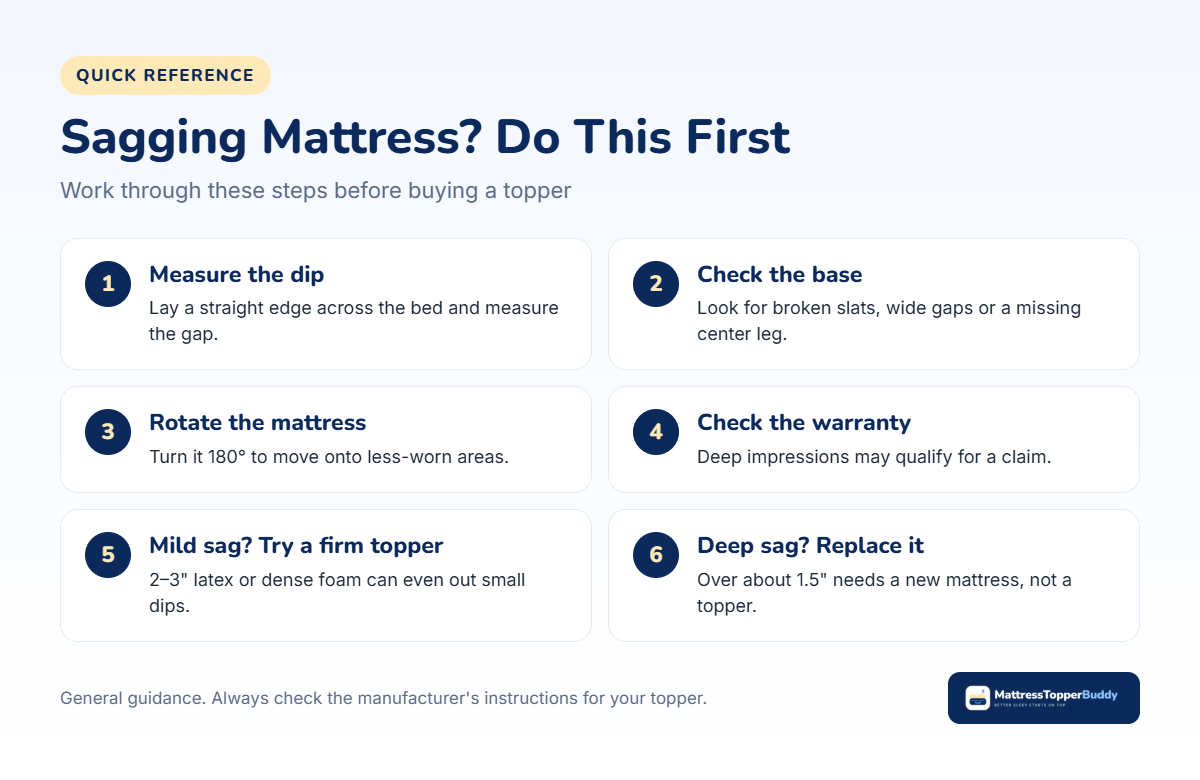
A mattress topper can mask very mild sagging (under about 1 inch) and make a slightly worn mattress feel more even, but it cannot fix real sagging. A topper follows the shape of the mattress underneath, so if the dip is 1.5 inches or deeper, the topper will sink into it too. For moderate or deep sagging, check your foundation, rotate the mattress, consider a warranty claim, or replace the mattress.
You wake up rolled toward the middle of the bed, your lower back feels stiff, and there’s a shallow valley where you sleep. A mattress topper looks like a quick, affordable solution. Sometimes it is. Often, it isn’t.
This guide explains why mattresses sag, how to measure how bad yours is, when a topper genuinely helps, and what to do instead when it won’t.
Why Mattresses Sag
Every mattress softens over time. The comfort foams near the surface slowly lose their bounce, springs fatigue, and fibers compress under years of body weight. Sagging usually shows up first where you sleep most, especially under the hips and shoulders, which carry the most weight.
Common causes include:
- Age. Most mattresses start showing wear after 6 to 8 years, sometimes sooner.
- Low-density comfort foams that break down faster.
- An unsupportive base, such as a bed frame with too few slats, widely spaced slats, or no center support on a Queen or King.
- Never rotating the mattress, so the same spots take all the pressure.
- Manufacturing defects in the foam or springs.
How to Measure Mattress Sag
Before you buy anything, measure the sag. It takes two minutes:
- Strip the bed down to the bare mattress.
- Lay a broom handle, yardstick or long straight board across the mattress where you sleep.
- Measure the biggest gap between the straight edge and the mattress surface.
- Repeat in a few spots: under your hips, under your shoulders and in the center.
Use this as a rough guide:
| Gap | What it means | Will a topper help? |
|---|---|---|
| Under 0.5 in | Normal softening | Yes, if you want a comfort change |
| 0.5–1 in | Mild wear | Partly; a firm topper can even it out |
| 1–1.5 in | Moderate sag | Short-term at best |
| Over 1.5 in | Significant sag | No; fix the support or replace |
Many mattress warranties cover body impressions beyond a set depth, often somewhere between 0.75 and 1.5 inches. If your measurement is in that range, check your warranty before doing anything else.
When a Mattress Topper Can Help
A topper is a reasonable fix when the sag is mild and the mattress is otherwise supportive. In that situation, a topper can:
- Fill in a shallow body impression so the surface feels more level.
- Add a fresh comfort layer over tired foams.
- Restore some pressure relief that the mattress has lost.
- Buy you time, perhaps a year or two, before you need a new mattress.
For this job, choose a firm or medium-firm topper made of latex or high-density foam, usually 2 to 3 inches thick. Firmer materials bridge small dips better instead of sinking straight into them.
Why a Topper Usually Can’t Fix Real Sagging
A topper is flexible by design. It drapes over whatever is underneath, so a deep valley in the mattress becomes a valley in the topper. You’ll still roll toward the dip, your hips will still sink lower than your shoulders, and your spine will still be pulled out of line.
Soft toppers make this worse. A plush memory foam or fiber topper on a sagging mattress can deepen the “hammock” effect, which is why some people find their back feels worse after adding a soft topper.
Avoid this
Don’t add a thick, soft topper to a sagging mattress to “even it out.” It sinks into the same dip and can make spinal alignment worse.
Better Fixes to Try First
1. Check your bed frame and foundation
Sometimes the mattress isn’t the problem at all. Remove the mattress and look at the base. Broken or missing slats, slats spaced more than about 3 inches apart, a sagging box spring, or a missing center support leg on a larger bed can all cause dips. Fixing the base can restore a surprising amount of support.
2. Rotate the mattress
Turn the mattress 180 degrees so the head becomes the foot. This moves your body onto less-worn areas. If your mattress is designed to be flipped, flip it too. Many modern mattresses are one-sided, so check the label first.
3. Add a firm board, carefully
A sheet of plywood between a sagging box spring and the mattress can firm up the base as a temporary fix. It won’t repair a sag in the mattress itself, and it can make some mattresses feel much harder.
4. Make a warranty claim
If the impression is deeper than your warranty’s threshold and the mattress is within the warranty period, contact the manufacturer. Keep your receipt, take clear photos with a ruler and straight edge in the shot, and make sure the mattress is clean and has been on a supportive base, since stains or an improper foundation can void coverage.
5. Replace the mattress
If your mattress is more than 7 to 10 years old, sags more than about 1.5 inches, or you wake up sore every morning, replacement is the real fix. A new mattress with dense comfort foams and a strong support core will do what no topper can.
If You Do Use a Topper on a Worn Mattress
If your sag is mild and you decide to try a topper, set yourself up for success:
- Choose firm latex or high-density foam, not soft memory foam or fiber.
- Keep it to 2–3 inches so it stays supportive.
- Rotate both the mattress and the topper every few months.
- Secure the topper with straps or a fitted cover so it doesn’t drift into the dip.
- Buy from a seller with a return window, so you can send it back if the dip shows through.
How to Prevent Your Next Mattress From Sagging
- Use a supportive base with slats no more than about 3 inches apart and center support on Queen and King beds.
- Rotate the mattress every 3 to 6 months, especially in the first year.
- Choose higher-density foams and a sturdy support core.
- Use a topper on top to absorb daily wear.
- Avoid sitting on the same edge spot every day, which can break down edge support.
Sagging vs Normal Softening: How to Tell the Difference
Not every change in your mattress means it’s failing. Almost all mattresses go through a break-in period and then soften slightly over the first few months as the foams settle. That’s normal and usually shallow and even across the sleep surface.
True sagging looks and feels different:
- It’s localized. The dip sits exactly where you sleep, often under the hips, while the rest of the bed feels firmer.
- It doesn’t recover. When you get up, the impression stays visible instead of slowly filling back in.
- It keeps getting deeper. Measure again after a month or two. Normal softening levels off; sagging keeps progressing.
- You feel it in your body. You roll toward the dip, feel like you’re sleeping “in” the bed rather than “on” it, or wake up stiff when you didn’t used to.
- Edges collapse. If the edge sinks sharply when you sit on it, the support core may be breaking down.
If your mattress is less than a year old and showing these signs, contact the seller or manufacturer straight away. Early sagging is often a defect and may be covered by a trial period or warranty.
What about memory foam impressions?
All-foam mattresses can show a light outline of your body for a few minutes after you get up. As long as it fills back in and measures well under an inch, that’s just how memory foam behaves, not a sign of sagging.
Frequently Asked Questions
What kind of topper is best for a slightly sagging mattress?
A firm or medium-firm latex or high-density foam topper, about 2–3 inches thick. Avoid soft memory foam and fiber.
Does a sagging mattress cause back pain?
It can contribute, because it lets your hips sink and pulls your spine out of line. If pain persists, speak to a healthcare professional.
Will flipping my mattress fix sagging?
Rotating or flipping (if the mattress is two-sided) can spread wear and reduce mild dips, but it won’t fix deep sagging.
Is sagging covered by mattress warranties?
Often, if the body impression exceeds the depth stated in the warranty and the mattress has been used on a proper foundation.
The Bottom Line
A firm topper can smooth out very mild wear, but it can’t fix a mattress that has truly sagged. Measure the dip first: under about an inch, a firm latex or dense foam topper is worth trying; beyond that, check your foundation, look at your warranty, and plan for a new mattress. For more on what toppers can and can’t do, see do mattress toppers really work?
This article is for general information only and isn’t medical advice. If you have ongoing pain or a health condition, talk to a healthcare professional.