Quick answer
A mattress topper is a removable layer of foam, latex, fiber, wool or feathers, usually 1 to 4 inches thick, that sits on top of your mattress to change how it feels. It can make a firm bed softer, a soft bed a little firmer, or a hot bed cooler. It cannot fix a mattress that sags or has lost its support.
If your mattress feels a little too hard, a little too old or a little too warm, someone has probably told you to “just get a topper.” It’s good advice for a lot of people, but only if you know what a topper is actually designed to do.
This guide explains what a mattress topper is, how it works, the different types you’ll see, and the simple signs that tell you whether a topper will help your bed or whether you’re better off saving for a new mattress.
What a Mattress Topper Is
A mattress topper is a separate comfort layer that lies flat on top of your mattress, underneath your fitted sheet. Most are between 1 and 4 inches thick and come in the same sizes as mattresses: Twin, Twin XL, Full, Queen, King and California King.
Think of it as a new “top floor” for your bed. Your mattress still provides the foundation and support underneath, while the topper changes the feel of the surface you actually lie on. Because it’s removable, you can take it off, clean it, move it to another bed or replace it without touching the mattress itself.
Toppers are made from many materials, including memory foam, latex, polyfoam, polyester fiber, down, feathers and wool. Each one feels different, which is why choosing the right material matters so much.
What a Topper Can Do for Your Bed
A good topper solves surface-level comfort problems. The most common reasons people buy one are:
- Softening a firm mattress. A soft memory foam or fiber topper adds cushioning so your shoulders and hips don’t feel like they’re pressing into a board.
- Adding a little support. A firm latex or high-density foam topper can make a slightly soft mattress feel more supportive.
- Relieving pressure points. Contouring materials spread your weight over a larger area, which many side sleepers find more comfortable.
- Sleeping cooler. Latex, wool and some cooling foams can feel less warm than a dense memory foam mattress.
- Reducing motion transfer. Memory foam absorbs movement, so you’re less likely to feel a partner turning over.
- Extending a mattress’s life. A topper takes some of the daily wear and can buy a still-supportive mattress a few more comfortable years.
What a Topper Can’t Do
A topper is not a mattress replacement. It follows the shape of whatever is underneath it, so if your mattress has a deep body impression, a sagging middle or broken springs, the topper will sink into that same dip.
As a rule of thumb, if you can see or feel a dip deeper than about an inch and a half, or you wake up stiff no matter how you sleep, the problem is support, not comfort. In that case a topper might help a little for a short time, but a new mattress, a firmer foundation or a warranty claim is the real fix.
Quick test
Lay a broom handle or a long straight edge across your mattress. If you see a gap of more than about 1.5 inches in the middle, your mattress has lost support and a topper won’t fully solve it.
Topper vs Mattress Pad vs Mattress Protector
These three products often sit side by side in stores and online listings, but they do very different jobs.
| Topper | Mattress pad | Protector | |
|---|---|---|---|
| Main job | Change how the bed feels | Add light padding and protection | Block spills, sweat and allergens |
| Typical thickness | 1–4 inches | Under 1–2 inches | Very thin |
| Comfort change | Noticeable | Slight | Almost none |
| Washable? | Usually only the cover | Often machine-washable | Yes |
Many people use all three: the protector against the mattress or over the topper, the topper for comfort, and the fitted sheet on top.
The Main Types of Mattress Toppers
Memory foam
The most popular type. It softens with body heat and contours closely to your shape, which feels like a gentle hug and relieves pressure well. It’s usually affordable and great at isolating motion, but traditional memory foam can trap heat and makes some people feel “stuck.”
Gel and cooling foam
Memory foam with added gel, copper, graphite or an open-cell structure. These aim to reduce heat build-up while keeping the contouring feel. The cooling effect is usually modest.
Latex
Springy, responsive and durable. Latex cushions you but pushes back, so it’s easier to move on and it sleeps cooler than most foam. It costs more and isn’t suitable for anyone with a latex allergy.
Fiberfill and down-alternative
Quilted toppers filled with polyester clusters. They feel plush and pillowy and are often machine-washable, but they offer little support and can flatten over time.
Featherbeds and down
Soft, airy and luxurious, with a sink-in feel. They need regular fluffing and may not suit people with feather allergies.
Wool
Fairly thin and firm, but excellent at regulating temperature and moisture. A good choice for people who run hot or cold.
Who Should Get a Mattress Topper?
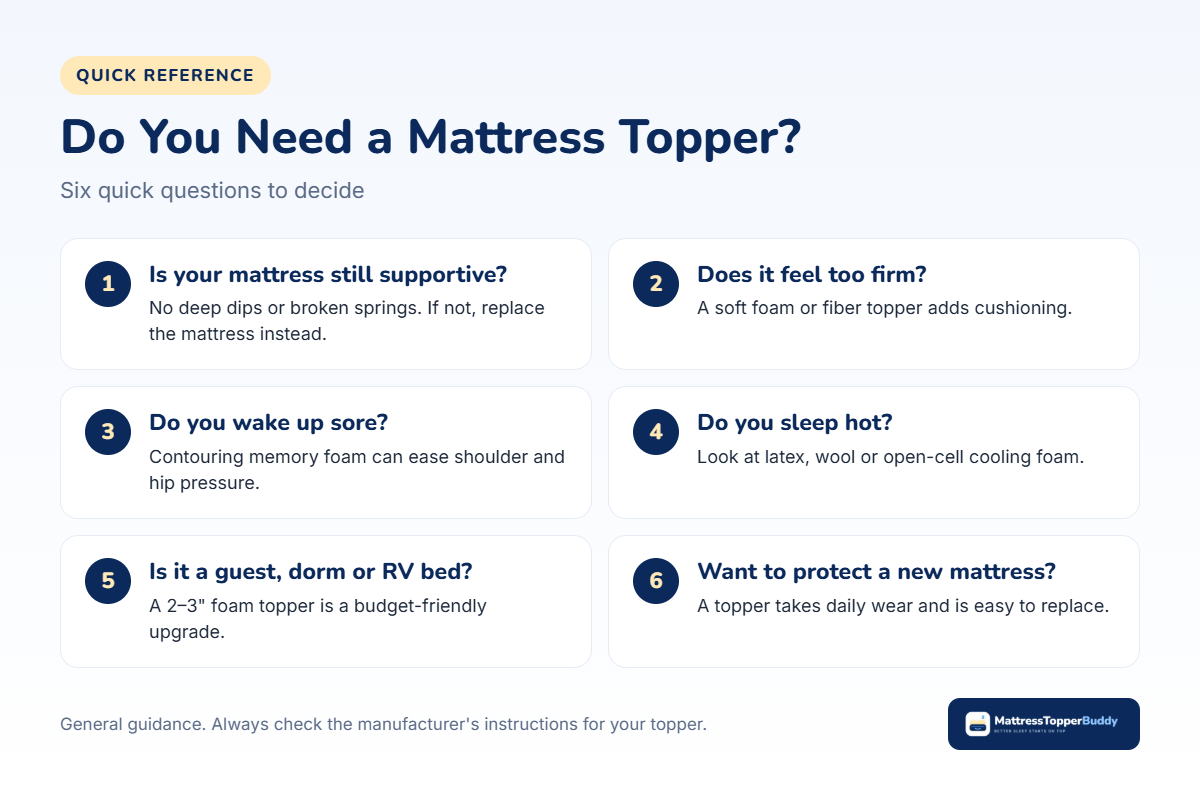
A topper is a smart buy if any of these sound like you:
- Your mattress is still supportive but feels too firm or too hard.
- You recently bought a mattress that’s firmer than you expected and can’t return it.
- You’re a side sleeper who wakes up with sore shoulders or hips.
- You sleep hot on a foam mattress and want a cooler surface.
- You want to make a guest bed, dorm bed, futon or RV mattress more comfortable on a budget.
- You want to protect a newer mattress from wear.
Who Should Skip It
A topper probably isn’t the answer if your mattress is sagging, more than 8 to 10 years old and visibly worn, or if you wake up in pain on every surface. It’s also worth thinking twice if you’re a stomach sleeper with a soft mattress, since adding a thick, soft layer can let your hips sink even further.
How Much Do Mattress Toppers Cost?
Prices vary widely by material, thickness and size. As a broad guide, fiber and basic polyfoam toppers sit at the budget end, memory foam is mid-range, and natural latex and wool are at the premium end. A Queen is usually the reference size; Twin sizes cost less and King sizes more. Even premium toppers are typically a fraction of the price of a quality new mattress.
How to Get the Most From a Mattress Topper
A few simple habits make any topper feel better and last longer. Unroll a new foam topper and give it 24 to 72 hours to fully expand and air out before you sleep on it. Use corner straps or a deep-pocket fitted sheet so it doesn’t slide around. Rotate it head-to-foot every few months so the same spots don’t take all the pressure, and keep a washable protector over it to guard against sweat and spills.
Finally, give yourself about a week to adjust. Your body is used to your old surface, so the first night or two on a new topper can feel strange even when it’s exactly the right choice.
Frequently Asked Questions
Does a mattress topper go on top of or under the sheet?
On top of the mattress and under the fitted sheet. Your sheet covers both the mattress and the topper.
How thick should a mattress topper be?
Three inches suits most people. Two inches is enough for a small adjustment, and four inches makes a big change to a very firm bed.
Can a mattress topper make a bed firmer?
A firm latex or high-density foam topper can add a little support to a slightly soft mattress, but it can’t fix one that sags.
How long does a mattress topper last?
Roughly 1–3 years for fiber, 3–5 years for memory foam and 5–10 years or more for latex, depending on quality and care.
The Bottom Line
A mattress topper is a simple, removable way to change how your bed feels without replacing it. It shines when your mattress is still supportive but too firm, too warm or a little tired. If your mattress is sagging or broken, though, put that money toward a new mattress instead. For help picking the right one, read our step-by-step guide on how to choose a mattress topper.