
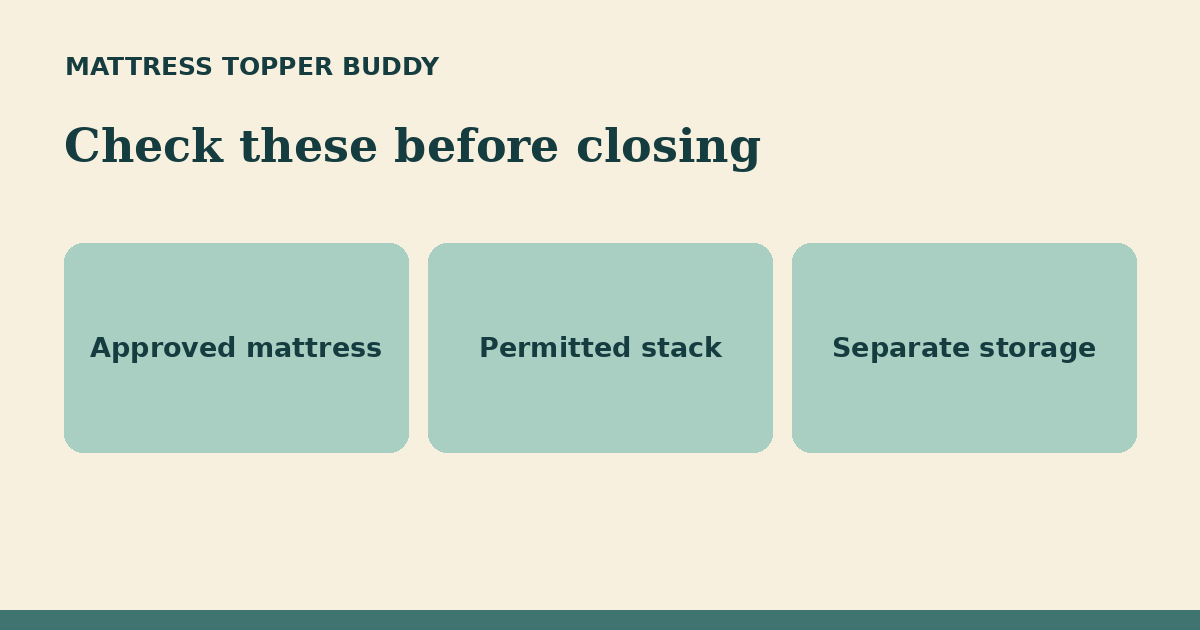
You can put a mattress topper on a Murphy bed for sleeping if the frame manufacturer allows it and the mattress underneath already meets the frame requirements. Whether you can close the cabinet with the topper in place is a second decision. Look for written instructions about the complete stack and which bedding can stay on the bed. If the manufacturer permits a topper while the bed is open but provides no approval for closing it with one attached, take the topper off and store it separately before closing the bed.
Identify the exact wall bed
Start with the frame label, assembly booklet or order confirmation. Write down the model number and whether the frame opens vertically or horizontally. A queen label describes only part of the setup. The cabinet, platform, hinge system and retention hardware determine what can travel with the bed when it closes. Two queen frames in the same showroom can use different mattresses or give different instructions about leaving bedding in place.
Read the current manufacturer guide for that model and market. For example, the Bestar Edge queen wall bed with wardrobe lists a 60-by-80-inch mattress, 8 to 12 inches thick and 60 to 90 pounds. Those specifications describe the mattress for that model. They do not authorize adding any particular topper to the mechanism. Use the manual’s terms to identify which numbers apply to the mattress, which apply to the open bed and which describe the allowed closed arrangement.

Confirm that the mattress meets the frame requirements on its own
Measure your mattress with the topper and loose bedding removed. Use the actual length, width and full uncompressed depth, including any sewn-in cushioning. Find the exact mattress model weight in its documentation or ask the seller. Shipping weights may include the carton. The weight of a topper should be identified separately rather than used to make an undersized or underweight mattress appear to fit a published mattress range.
A mattress that fills a platform properly can still be the wrong weight or thickness for a given wall bed. Some manufacturers specify a minimum as well as a maximum mattress weight because of how the lifting system works. If yours does, use an approved mattress before evaluating a topper. Likewise, follow any instructions on mattress construction. A mattress label such as innerspring, hybrid or foam is only useful if the frame’s manual tells you how to apply that information.
Ask what can remain on the bed when it closes
Look for language about mattress straps, bedding and cabinet depth. A strap that is shown across the mattress can have a specific job and routing. Its presence does not by itself mean loose foam, a thick protector or a duvet may be kept underneath it. If the instructions distinguish sheets from thicker bedding, use that distinction. If they omit toppers, ask the model’s support team for the approved arrangement before trying it.
Send support the frame model, mattress model and weight, topper dimensions and weight, and the depth of the made-up stack without compression. Explain whether the topper has a skid-resistant underside, a cover or attached bands. Ask whether it may stay on the bed during closure and how it must be positioned if permitted. Keep the response with the manual so everyone who uses the guest room follows the same routine.
Work through a sample clearance question
Suppose a quoted mattress limit is 12 inches. Your mattress measures 10 inches and the topper measures 2 inches. Together they are about 12 inches before you account for a textured cover, protector or folded blanket. The calculation tells you the approximate uncompressed depth of those two pieces. It does not tell you that the model can safely close over them. You still need approval for a two-piece stack because it behaves differently from one mattress as the platform moves.
Now suppose the mattress is 11½ inches deep and you plan to add a 1½-inch topper. The combined layers measure about 13 inches. If the actual manual explicitly limits the entire closed stack to 12 inches, that setup already exceeds it before the sheets go on. Keep the topper separate during closure if the manufacturer permits you to use it while the bed is open. If the dimensions you have are a mattress-only range, do not turn that range into a closed stack specification. Ask the manufacturer how to interpret it.
Choose a topper for how often the bed is used
An everyday wall bed puts a premium on a simple routine. If the topper needs to come off each morning, think about whether you can remove it and put it away without blocking the room. A wide slab can be awkward to carry even when it weighs less than a box of books. Handle it as its own manufacturer directs. If wall-bed storage is limited, buy only after finding a suitable place for the topper and checking the path to that place.
For a guest bed, choose how much change you want to make to the existing sleep surface. If it feels even but more firm than you prefer, compare options by feel as well as thickness. Our guide to topper thickness explains how much a two-, three- or four-inch layer contributes to a bedding stack. Use the wall-bed requirements first and then compare comfort options that fit your routine.
Set up and store removable bedding in the right order
- Open the frame according to the manual. Confirm that the platform and any support legs are positioned as specified.
- Set the topper on the sleeping surface. Follow its orientation instructions, align the edges and check that no cover or band extends toward moving hardware.
- Fit the protector and sheet. Check the entire depth of the stack and make sure the sheet holds without pulling the topper corners down.
- Separate the removable layers before closure when required. Set them on a clean, dry surface away from the moving bed. Return the retention system to its specified configuration.
- Close the bed only in its approved arrangement. Follow the frame guide. If closing feels different, stop using the mechanism and consult the manual or manufacturer.
Try the routine once before a guest arrives. Leave enough room to reach sheet corners without leaning on an unsupported part of the platform. If someone else will use the bed, show them where the topper belongs before closure. A nearby storage space that keeps the topper flat according to its care instructions may be easier to use than a deep cupboard in another room. Confirm that the chosen spot does not obstruct foot traffic or access to the cabinet.
Know when the topper is solving the wrong problem
If the open mattress is level and you simply want to adjust the surface feel, a compatible topper can be a reasonable choice. If you are trying to address an uneven platform, a mattress that slips out of its intended position or a frame that no longer moves as designed, follow the manufacturer’s troubleshooting process before using the bed. Extra fabric or foam can make an underlying problem harder to see during a quick inspection.
Check the causes one at a time. A poorly fitted sheet can pull a topper corner inward. A loose topper can shift while you make the bed. A difference in the platform’s position calls for the frame instructions. Compare what you see before and after adding each layer. That gives support staff precise details and helps you avoid ordering a thicker topper for a problem that began with the setup underneath.
Measure storage access as well as storage space
A shelf may be long enough for the topper and still sit behind a door that opens only partway. Check the opening with the room arranged for guests. Measure the path past a desk, chair or bedside table, and think about where the cover and fitted sheet go while the topper is off. Keeping dry bedding together makes the changeover easier. If the topper maker requires flat storage, the space needs to support its footprint in that position.
Frequently asked questions
Can I leave a thin topper on when closing the bed?
Use the manufacturer’s answer for the exact model. Even a thin layer changes what the retention hardware must hold. Give support the topper’s thickness, weight and construction when asking. If they authorize it, follow any instructions about placement and bedding.
Can I use the wall bed straps to attach the topper?
Use the straps for the components and routing shown in the frame instructions. If the manual only shows them securing the mattress, ask before including an additional layer. Avoid adding independent hardware to the frame without the manufacturer’s approval.
Does a horizontal wall bed change the answer?
The cabinet and mechanism still determine the rules. Because the frame opens from a different edge, do not transfer instructions from a vertical model. Check the exact frame and measure the mattress in the orientation in which it will be installed.
Conclusion
Confirm the approved mattress specifications first. Then decide separately whether your topper can stay on while the wall bed closes. If the frame maker approves open-bed use only, plan a convenient storage spot and remove the topper every time you close the cabinet.