
For a mattress topper warranty claim, gather proof of purchase, photos of the whole topper and its label, and clear views of the issue. Then follow the warranty and submission instructions for the exact model in the country where you bought it. For an impression, ask whether the maker wants a measurement, how the topper should be supported and how long it should rest before you take the photo. A mattress warranty’s indentation threshold may describe the mattress only.
Find the terms tied to your purchase
Open your receipt or order confirmation and identify the seller, model, size and purchase date. A single brand can issue different warranties for different materials, product versions or sales channels. If the maker has a current website and a printed warranty came in the carton, save both. Ask support which terms apply if the language or warranty duration differs. A support agent can usually do more with the model and transaction together than with a picture of an unlabeled piece of foam.
Read the sections covering eligibility, exclusions, remedies and submission instructions. Pay attention to whether the seller or the maker handles the first contact. A marketplace listing can show the brand prominently while another merchant fulfills the sale. Be ready to provide the seller information from the order, especially if the warranty specifies an authorized retailer. Use private support channels for receipts and any necessary personal details.
Describe what you can observe
Write one sentence that names the issue and where it occurs. For example, the foam has a visible split near the foot-end corner, or the unloaded surface stays low in the middle after the specified rest period. A statement that the topper feels uncomfortable can be accurate but gives the reviewer a different question. Describe any change in feel separately so support can tell whether you are reporting a physical change or asking about a preference-based return.
Take a photo before rearranging layers if the issue is visible in the normal setup. Remove loose bedding for a separate set of photos according to the claim instructions. If the mattress is uneven, explain that and photograph the topper using the support surface the manufacturer requests. Changing the underlying bed and turning the topper at the same time makes the resulting photos less useful. Our guide to topper rotation explains how changing one layer at a time can help isolate where a problem follows.
Photograph the topper in a repeatable sequence
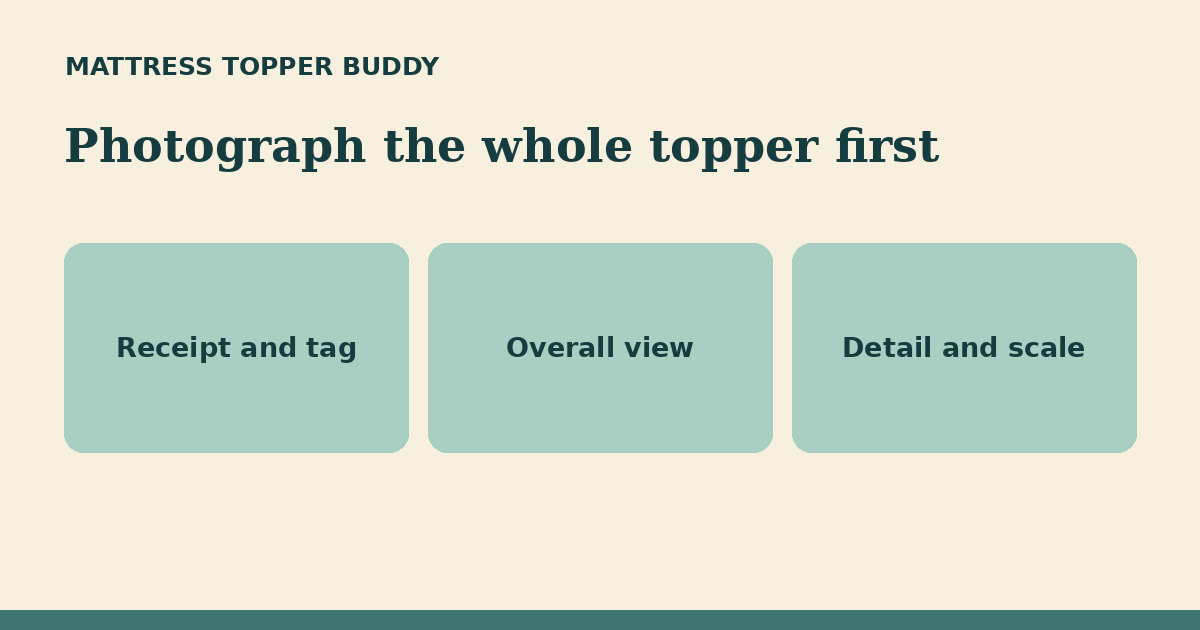
- Order evidence. Get the receipt or confirmation with the item plainly identified.
- Entire topper. Step back far enough to show all four edges with the cover in the position requested.
- Location and detail. Take a wider photo to show where the issue occurs, then a close photo with clear lighting.
- Product label. Photograph the complete label clearly, including the product name and relevant codes.
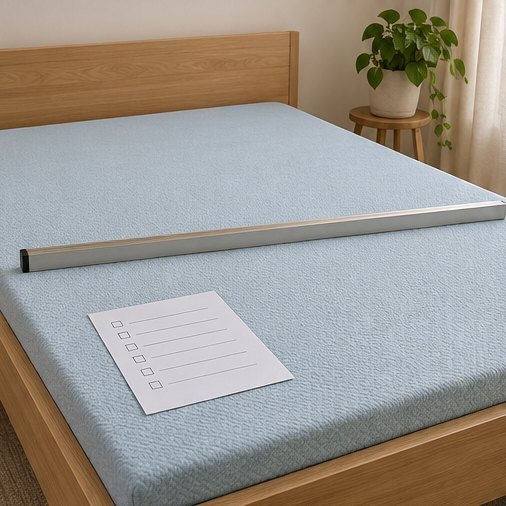
- Requested measurements. Include the straightedge, ruler and support setup if the maker specifies them.
For a model-specific example, Tempur-Pedic’s request for topper claim photos lists purchase proof, a full product photo with the cover on, a photo of the affected area and the law tag. Follow your own manufacturer’s exact list even if you already collected the examples here.
Measure an impression only as directed
A measurement is easier to interpret when there is no pressure on the surface and the scale can be read from the camera angle. If the maker requests a straightedge across the impression, place it on the reference areas specified in its directions. Let the ruler show the gap to the surface without pushing into the material. Photograph the wider setup as well as the reading. A close-up of a ruler with no visible reference line cannot show what the number measures.
Keep the cover on or off according to the instructions. If the topper is quilted, profiled or intentionally beveled, avoid treating every change in height as evidence of an impression. Record where you measured, for example at the center near the middle seam. If the material recovers gradually, record the time it has been unloaded. Compare like conditions if support asks you to send another measurement.
Work through an example without assuming coverage
Imagine a homeowner finds a low area near the middle of a two-inch topper. The mattress below also looks uneven with all the bedding removed. The first photo shows both items as they were used. Then the homeowner follows the seller’s instructions to lay the topper flat, waits the requested period and photographs the unloaded surface. That set of images lets the reviewer see the normal setup and compare it with the topper on the requested support.
Suppose the straightedge photo appears to show a half-inch gap. Write down the reading and method, then send both to support. Do not use a threshold borrowed from the mattress section of a general warranty page. For example, Tempur-Pedic’s defect guidance lists different examples for toppers and mattresses. Its topper section describes material splitting or a failure to recover. Let the maker apply the terms for your own model and purchase.
Explain prior handling as part of the timeline
Note when you unpacked the topper, how long it took to recover and when the issue became visible. Mention anything that helps reproduce what you saw, such as whether the cover was on or the topper was being moved. Give dates when available and label estimates clearly. If support has already sent instructions, keep the original message and describe what you did in response. That makes it easier for another representative to follow the claim if it is reassigned.
Keep the product and packaging you still have until the seller tells you what to do next. Avoid cutting the foam, opening a permanent liner or discarding the label while the claim is active. If the review requires another angle or a clearer image, keep the originals and send the requested follow-up with the same case number. Add a short caption identifying each photo if the portal accepts it.
Check what happens after a decision
If the review approves a claim, ask whether the remedy is repair, replacement or another option described in the warranty. Confirm any shipping arrangements, whether the original product must be returned and what to keep in the meantime. If an alternative model is offered, verify the exact dimensions, cover and thickness so the replacement fits the same bed. Keep the new order or shipment reference with the claim correspondence.
If support says the claim is incomplete, ask which item is missing and what format they want. If it says the issue is outside the terms, ask which clause or product criterion was applied if that is unclear. Save the message rather than restarting from a different support channel with a second case. A clean record of the item, evidence and replies is more useful than several overlapping submissions.
Make the first support message easy to act on
Open with the model, size and order reference. State when the issue appeared and whether it was present on delivery. Point to the one photo that best shows the concern, then add the broader images for context. If there are several problems, list them separately and say which photos go with which problem. A split in the insert and a broken cover zipper may require different images and different questions from the reviewer.
For example, a useful note could say that the topper has a split on the foot-end corner, the cover is intact, and the receipt, tag, overall photo and close-up are included. If you left out a measurement because you could not find model-specific instructions, say so and ask what method to use. Keep the narrative short and let the photos show what can already be seen. Before submitting, check whether the portal compressed the images enough to make the tag or ruler unreadable.
Frequently asked questions
Can I use a bank statement instead of a receipt?
Ask what the reviewer accepts. A payment record may show the merchant and amount but omit the model or date details required to match the claim. A duplicate receipt from the seller or order history may provide a clearer match.
Should I wash the cover before taking photos?
Ask first if the condition of the cover is part of the issue. Follow the care label and the evidence requirements. Photograph the state you first observed, and keep loose bedding off the topper when the instructions call for a clear view.
Does a warranty work like a trial?
Read both policies. A trial addresses whether an eligible purchase can be returned after use. A warranty describes covered defects and applicable remedies. If the topper arrived with a split or a wrong label, describe precisely what happened so support can route the request.
Conclusion
Match the warranty to the exact topper, document the issue under the conditions requested and preserve the original photos and labels. A clear set of records helps the reviewer identify the item and assess the concern without guessing which layer or measurement is involved.