
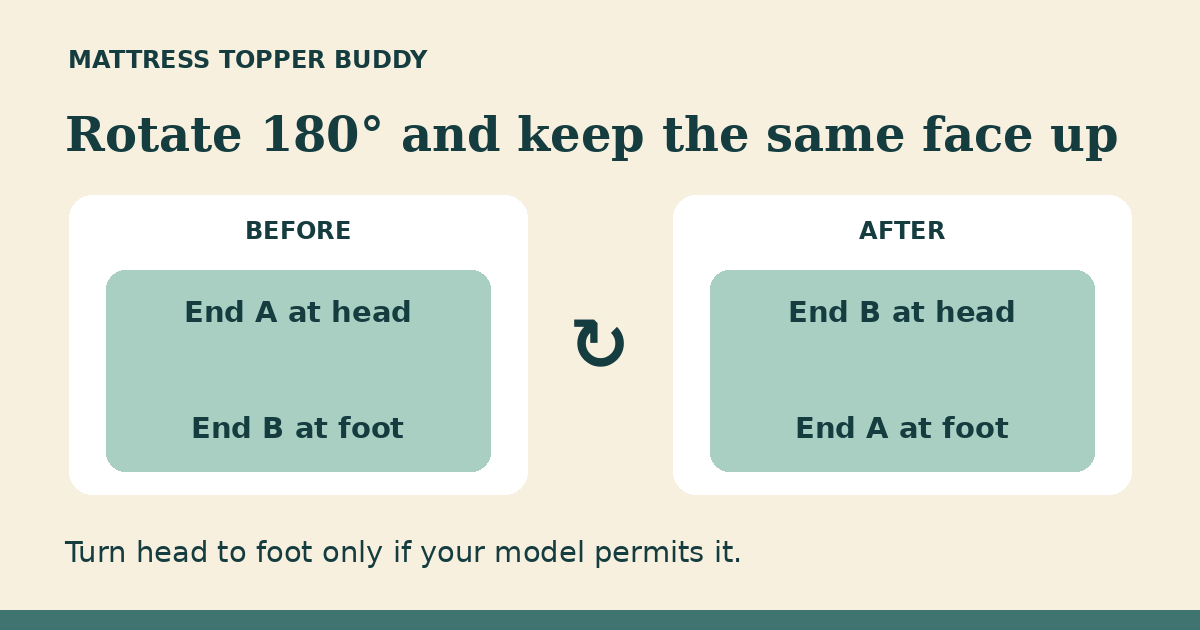
Rotate a mattress topper head to foot when its manufacturer permits it and both ends are designed to work in either position. Keep the same sleeping face up. If the topper has a labeled head end, zones that differ from one end to the other, or fittings that match only one end of the bed, leave it in the specified orientation. Check the care guide for a rotation interval. If there is no interval, the next time you strip the bed is a good opportunity to inspect the topper and decide whether a turn makes sense.
What changes when you rotate a mattress topper?
A half-turn swaps the head and foot and also swaps the left and right sides. The upper surface stays uppermost throughout. Flipping the topper turns its bottom surface upward, which can change the feel or put a grip backing, a cover underside or a flat base against the fitted sheet. A quarter-turn swaps the length and width. For a rectangular topper, that usually means the edges will no longer match the mattress.
Picture a foam topper with an imaginary label A at the head and label B at the foot. After rotation, B is at the head and A is at the foot. If you sleep on the left side, the foam that was at the upper left is now at the lower right. That change is the reason a rotation can redistribute future use. The movement cannot rebuild material that has already compressed or repair a mattress that sags beneath the topper.
Check whether your topper can be turned head to foot
Start with the model label or order history. Look for installation instructions as well as cleaning directions. A product page may show a top and bottom in a diagram but leave head and foot orientation to a separate insert in the package. Look for words such as shoulder, foot, head, lumbar or directional. If all you have is a picture of a textured surface, ask the seller which end belongs near the headboard before assuming that the pattern is symmetrical.
A plain rectangular insert with uniform material across its footprint is the simplest candidate. The cover still needs to work after the turn. Check whether all corner bands line up with the mattress corners and whether a zipper or label will be uncomfortable or inaccessible at the other end. A cover with a non-slip underside can remain facing downward during rotation. If the cover or bedding is the only part moving, reseating it may address the problem without changing the topper’s orientation.
For a topper with visibly different zones, compare the two ends using the manufacturer’s illustration. Some repeating patterns look alike in a photo taken from a distance. On the bed, one area may put a softer section under the shoulders while another is designed for the legs. A permanent stitched layer, cutout or mixed firmness section can also be directional. Treat an end-specific instruction as decisive even if the foam would physically fit after turning.
How often should you rotate it?
Use the interval for your specific product if one is provided. For example, ViscoSoft’s topper guidance suggests a three- to six-month rotation for its readers. That is a manufacturer example. Check your own model before adopting the interval, especially when the design or instructions specify one end at the head of the bed.
If the maker permits rotation without setting a schedule, tie the inspection to a task you already do. When the protector comes off for cleaning, look along the topper’s surface, check the bands and note any area that feels different. Record when you rotated it and what you observed. A heavily used bed and an occasional guest bed may show different wear even with the same topper. The difference is a reason to inspect how each one is used instead of turning them blindly on the same day.
Turn the topper without folding it sharply
- Make space. Strip the bedding, clear nearby objects and release any straps as instructed. If your frame adjusts, put it in the position specified for handling the bedding.
- Note the current orientation. Use the care label or zipper location as a reference. If there is no built-in marker, take a photo or place a loose note beside one end while you work. Keep adhesive off the foam.
- Support the topper while turning it. For a wide or delicate piece, get help and use enough of the mattress or another suitable flat surface to support the sheet of foam. Keep the upper surface up as you exchange head and foot. If the wall or furniture blocks a flat turn, clear more space or use the manufacturer’s recommended handling method.
- Align all four sides. Center the topper on the mattress and refit the bands where present. Smooth the cover and make sure the sheet and protector do not curl a corner as you put them back.
Watch the foam while you work. A corner can fold underneath itself when one person pulls while the other holds the opposite end. Pause and reset the piece if you see a fold forming. Use the support method specified by the maker instead of pulling on a zipper, carrying strap or corner band that was intended only to anchor the bedding. If the topper is too awkward to move under those conditions, an inspection in its current position still tells you whether it lies flat and how the cover is sitting.
A worked example for a queen bed
Suppose you have a uniform queen topper measuring roughly 60 by 80 inches and the instructions allow head-to-foot rotation. You sleep near the left edge and commonly sit on the same corner to put on shoes. Once the bedding is off, photograph the topper and mark the occupied area relative to a sewn label. After the half-turn, check that the same area of foam has actually moved to the opposite side and end. All four edges should still line up because a half-turn preserves the rectangular footprint.
Now try the bed with the usual protector, sheet and pillow. Keep the mattress and frame in their original positions during that comparison. If the sensation moves with the rotated foam, the topper or its cover is a likely contributor. If you feel it in the same spot on the bed, inspect the bare mattress and its support next. You can repeat the check with the permitted cover placed correctly and the sheet tension relaxed. Keep only one change between checks so that the result has a clear interpretation.
Tell a moving topper from a worn topper
Take the fitted sheet off and compare the topper edges against the mattress. A strip of exposed mattress on one side and an overhang on the other suggest the topper has moved sideways. A central low spot that remains on a suitable level surface when the topper is unloaded points to a different question. Give the product any recovery time it requires, then take a second look and follow the maker’s method for documenting impressions. Record whether the cover was on, because fabric can obscure an edge or pull it inward.
Look at the mattress with the topper off if the bed still feels lower in the same place. A pillow-top seam or shallow quilt pattern can look like a dip when viewed from a sharp angle. Compare the manufacturer’s inspection directions before interpreting a photo or ruler reading. Rotation is most useful as routine care on a compatible, intact topper. If your concern is a persistent tear, low spot or peeling layer, gather photos and ask about the appropriate remedy.
Recheck how the bedding fits after the turn
A compatible half-turn leaves the topper’s overall length and width the same, but can move seams and straps to a different spot. Run your hand along all four edges as you refit the sheet. If the last corner requires more force than the others, refit it and compare how it sits before and after the sheet goes on. A sheet that pulls hard across a prominent seam can make a corner appear permanently bent when the topper lies flat on its own.
For a bed with a narrower or shorter layer that never quite matched in either position, rotation does not change its dimensions. Measure both pieces and decide whether their fit works before changing any attachment. Our full topper on a queen bed guide shows how even a centered topper can leave uncovered edges when the footprints differ.
Frequently asked questions
Can I rotate an egg-crate topper?
Check whether its contours repeat along the entire length and whether the maker allows the turn. If the design reserves particular peaks or valleys for specific body areas, follow the indicated layout. Keep the face that the manufacturer identifies as the sleeping face upward.
Can I rotate a topper on a split mattress?
Read the topper and bed instructions together. If each half has its own topper, measure and inspect each piece separately. Note which sleeper uses which piece, especially if the toppers have different firmnesses. A split or shaped unit with a designated head end needs to keep its intended layout.
Can I rotate the mattress and topper on the same day?
Follow the separate care advice for both products. If you are tracking down an uneven feel, change one piece at a time so you can see whether the sensation moves with it. If you already know both products can be turned and are only doing normal upkeep, keep their correct sleeping sides up.
Conclusion
Confirm that your topper permits a half-turn, support it as you move it and check that the same face remains up. Use the model’s care interval if available. If a problem stays in the same place after rotation, inspect the layer or support below it before deciding which part needs attention.
1 thought on “Should You Rotate Your Mattress Topper? When and How”