
Quick answer
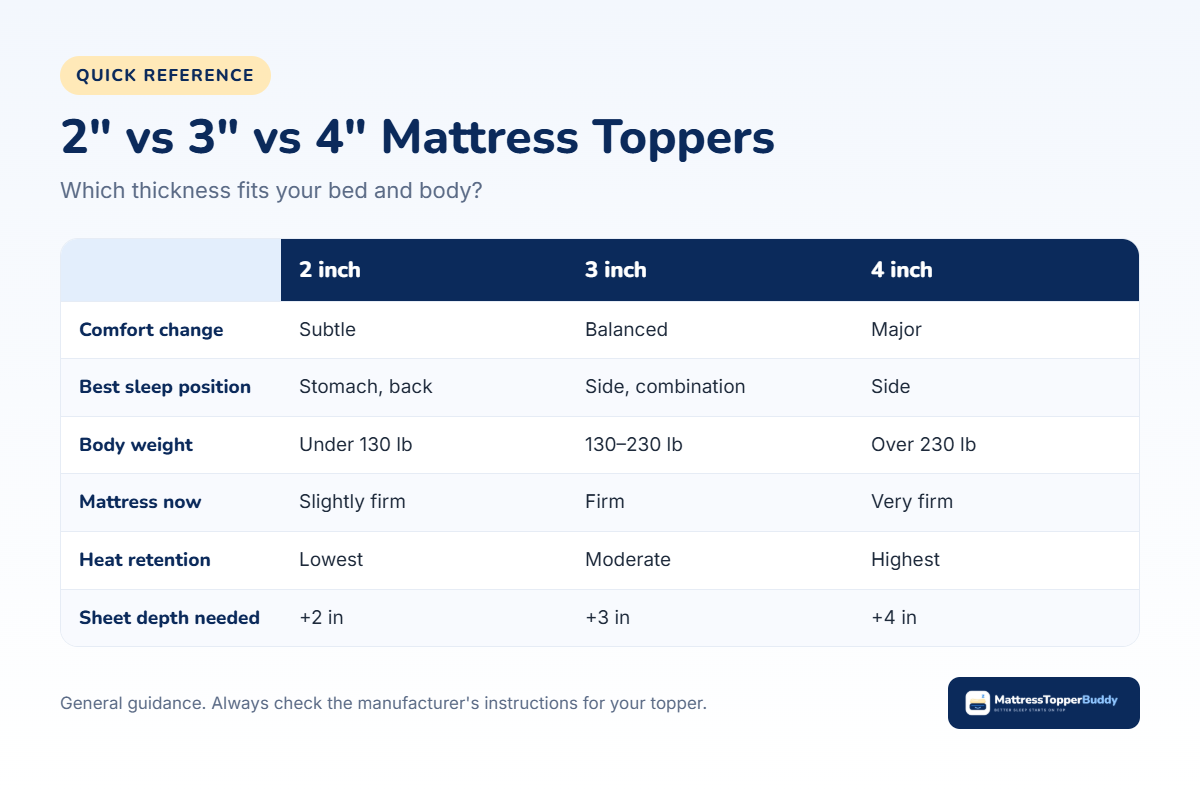
For most people, a 3-inch mattress topper is the right thickness: enough to soften a firm mattress and relieve pressure without feeling unsupportive. Choose 2 inches (or less) for a subtle change, for adding firmness with latex, or if you sleep on your stomach. Choose 4 inches if your mattress is very firm, you’re a side sleeper with sharp pressure points, or you weigh over about 230 lb.
Thickness is one of the first numbers you’ll see on any topper listing, and it has a bigger effect on how your bed feels than almost anything else. Too thin, and you may barely notice the topper. Too thick, and you can end up sinking so far that your spine falls out of line.
The good news is that choosing the right thickness is fairly simple once you know three things: how firm your mattress is now, how you sleep and how much you weigh. This guide walks through each option and helps you match it to your situation.
Why Topper Thickness Matters
A topper works by giving your body a new layer to sink into before it reaches the mattress. The thicker that layer, the more cushioning it can provide and the more it changes the overall feel of the bed.
But thickness doesn’t work alone. A 3-inch firm latex topper feels completely different from a 3-inch soft memory foam topper. Think of thickness as the amount of change and firmness as the direction of change. Together, they decide whether your bed ends up softer, firmer or just slightly different.
Thickness also affects practical things: bed height, how well your fitted sheets fit, how much the topper weighs and how easy it is to move or store.
Common Topper Thicknesses at a Glance
| Thickness | How much it changes the bed | Best for |
|---|---|---|
| 1–1.5 in | Very little | Light refresh, protecting a new mattress |
| 2 in | Noticeable but subtle | Stomach sleepers, adding firmness with latex, slightly firm beds |
| 3 in | Clear, balanced change | Most sleepers, especially side and combination |
| 4 in | Major change | Very firm mattresses, heavier sleepers, sharp pressure points |
| 5 in + | Almost a new comfort system | Specialty uses; can feel unsupportive for many people |
2-Inch Mattress Toppers
A 2-inch topper is the gentle option. It adds a layer of comfort you’ll definitely feel, but it won’t dramatically change the character of your mattress.
Choose 2 inches if:
- Your mattress is only slightly too firm.
- You sleep on your stomach and need to keep your hips level.
- You want to add a little firmness with a firm latex topper rather than soften the bed.
- You’re lightweight, so you won’t compress a thicker topper anyway.
- You want something easy to roll up and store, for a dorm, RV or guest bed.
Watch out for: a 2-inch topper won’t rescue a very hard mattress, and heavier sleepers may “bottom out” through it, feeling the mattress underneath.
3-Inch Mattress Toppers
Three inches is the most popular thickness for good reason. It’s deep enough to make a firm mattress noticeably softer and to relieve pressure at the shoulders and hips, but not so deep that most people feel like they’re sinking.
Choose 3 inches if:
- You’re a side or combination sleeper on a medium-firm to firm mattress.
- You want a clear improvement in comfort and pressure relief.
- You’re an average-weight sleeper (roughly 130–230 lb).
- You want better motion isolation from a memory foam topper.
Watch out for: a soft 3-inch topper on an already soft mattress can be too much for back and stomach sleepers. In that case, choose a firmer 3-inch topper or drop to 2 inches.
4-Inch Mattress Toppers
A 4-inch topper is a big upgrade. It can make a hard mattress feel plush and gives heavier bodies enough material to sink into without hitting the mattress below.
Choose 4 inches if:
- Your mattress feels very firm or hard, like a guest bed or an old futon.
- You’re a side sleeper with sore shoulders and hips.
- You weigh more than about 230 lb and thinner toppers feel like they disappear.
- You want a near “new bed” feel on top of a supportive base.
Watch out for: 4-inch foam toppers are heavy, can sleep warmer (more foam means more insulation) and add a lot of height, so you may need deep-pocket sheets. A thick soft topper can also make it harder to change positions.
2 Inch vs 3 Inch: Which Should You Choose?
If you’re stuck between the two, ask yourself how much your mattress bothers you right now. If it’s “a little too firm” or you sleep mostly on your stomach or back, go with 2 inches. If you wake up with pressure points or your bed feels genuinely hard, go with 3 inches. Side sleepers almost always prefer 3 inches over 2.
3 Inch vs 4 Inch: Which Should You Choose?
Most average-weight sleepers are happy with 3 inches. Step up to 4 inches if your mattress is very firm, you’re a heavier sleeper or you’re a side sleeper who still feels pressure on a 3-inch topper. If you sleep hot, a 3-inch latex or open-cell foam topper is often a better choice than 4 inches of dense memory foam.
How Your Mattress Affects the Right Thickness
- Very firm mattress: 3–4 inches of soft to medium foam or fiber.
- Medium-firm mattress: 2–3 inches, depending on how much softer you want it.
- Slightly soft mattress: 2 inches of firm latex or high-density foam to add support.
- Sagging mattress: no thickness will fix it. A topper will sink into the dip.
How Body Weight Changes the Answer
Lighter sleepers (under about 130 lb) don’t compress toppers very much, so a 2 to 3-inch topper usually feels plenty soft. Heavier sleepers (over about 230 lb) sink further and compress foam faster, so 3 to 4 inches of dense foam or latex gives them the cushioning they need without bottoming out. Couples with very different weights may find a 3-inch medium topper the best compromise.
Tip
Add your mattress height and topper thickness before you buy sheets. A 12-inch mattress plus a 4-inch topper needs fitted sheets with at least 16-inch pockets, ideally a little deeper.
Does Thickness Affect Temperature and Durability?
Yes, in both cases. Thicker foam toppers hold more heat simply because there’s more insulating material between you and the mattress, so hot sleepers should favor thinner toppers or more breathable materials. On the other hand, thicker toppers of the same density usually last longer, because the wear is spread through more material before you start to feel the mattress below.
Matching Thickness to Topper Material
The same thickness can feel quite different depending on what the topper is made of, so it’s worth adjusting your choice to the material:
- Memory foam: 2 inches for a light softening, 3 inches for most people, 4 inches for very firm beds. Because memory foam compresses slowly under heat and weight, it tends to feel softer and deeper than its thickness suggests.
- Latex: latex is buoyant and pushes back, so a 2-inch latex topper can add real support, and 3 inches feels cushioned without much sinkage. Four-inch latex toppers are heavy and usually only necessary for heavier side sleepers.
- Fiberfill and down-alternative: these are often sold by loft, like 3 to 5 inches, but they compress a lot when you lie on them. A 4-inch fiber topper may only feel like 1 to 2 inches of cushioning once it settles.
- Featherbeds: similar to fiber, the advertised height drops quickly under body weight, so thicker baffled designs hold up better.
- Wool: usually 1 to 2 inches. Wool is about temperature control rather than deep cushioning, so thickness matters less.
In short, if you’re choosing a fiber or feather topper, lean toward the thicker end of the range; if you’re choosing latex, you can often go a little thinner than you would with memory foam and still get the support you need.
Can you stack two thin toppers?
You can, for example a 2-inch latex topper under a 1-inch wool topper. Just secure both layers so they don’t slide against each other, and remember that stacking adds height and heat.
Frequently Asked Questions
Is a 2-inch mattress topper enough?
It is for small adjustments, stomach sleepers, lighter people or adding firmness with latex. For a very firm bed or side sleeping, 3 inches is usually better.
Is a 4-inch topper too thick?
Not for very firm mattresses or heavier sleepers. For a soft mattress or a stomach sleeper, it can be too much and let the hips sink.
What thickness is best for side sleepers?
Usually 3 inches, or 4 inches if the mattress is very firm or the sleeper is heavier.
Will a thicker topper make me sleep hotter?
It can, especially with dense memory foam. Latex, wool or open-cell foam help offset this.
The Bottom Line
Start with 3 inches unless you have a clear reason not to. Go thinner for subtle changes, stomach sleeping or added firmness; go thicker for very firm beds, heavier bodies or stubborn pressure points. Pair the right thickness with the right firmness and material, and your topper will feel like a real upgrade. For the full picture, read our guide on how to choose a mattress topper.
2 thoughts on “How Thick Should a Mattress Topper Be? 2 vs 3 vs 4 Inch Explained”
Comments are closed.