
Quick answer
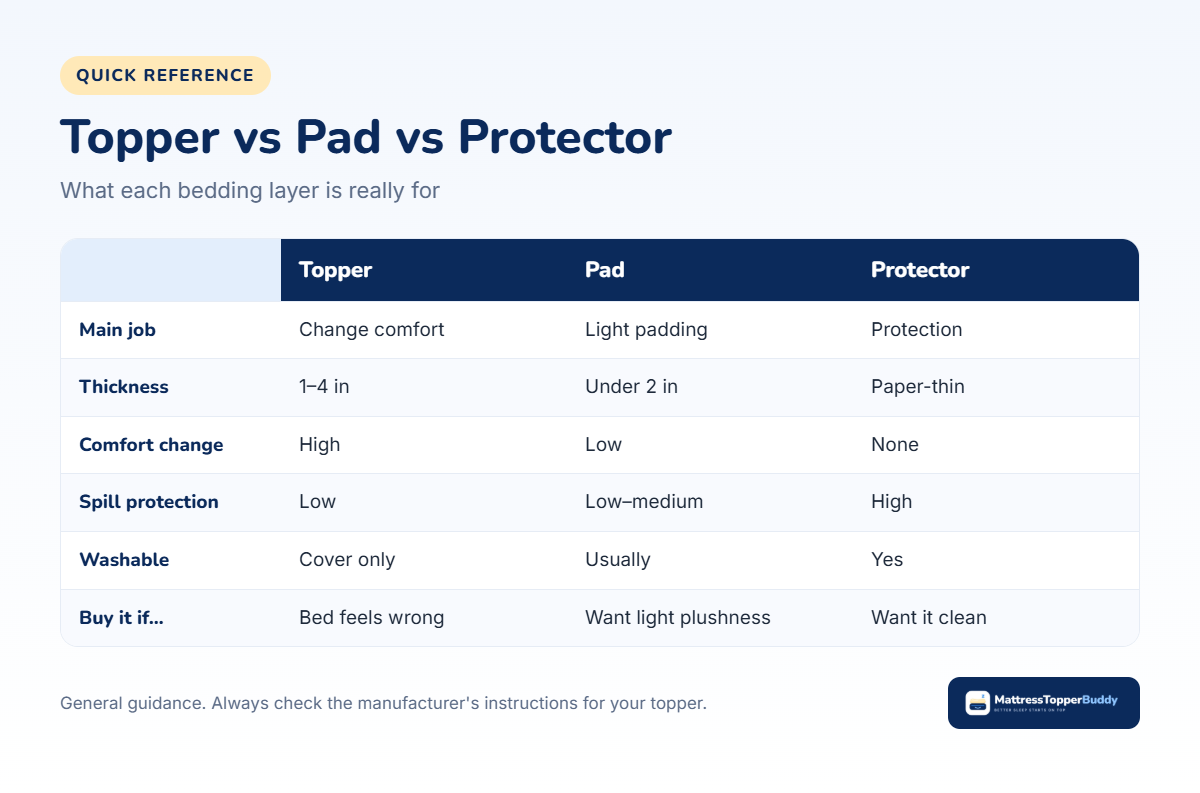
A mattress topper (1–4 inches) changes how your bed feels. A mattress pad (usually under 2 inches) adds a little cushioning and some protection. A mattress protector is a thin, often waterproof cover that guards against spills, sweat and allergens but barely changes comfort. If you want a softer or firmer bed, buy a topper; if you want to keep your mattress clean, buy a protector.
Walk down any bedding aisle and you’ll see toppers, pads and protectors stacked side by side, often with similar photos and overlapping claims. It’s no surprise people mix them up. But buying the wrong one can mean spending money on a “comfort upgrade” that you can’t even feel, or on a plush layer that doesn’t protect your mattress at all.
Here’s a clear breakdown of what each layer does, how they compare, and how to combine them for the most comfortable and longest-lasting bed.
The Short Version
Each layer has one main job:
- Topper: comfort. It noticeably changes the feel of your mattress.
- Pad: light comfort plus light protection. It softens the surface slightly and absorbs everyday wear.
- Protector: protection. It creates a barrier against liquids, sweat, dust mites and allergens.
The easiest way to remember it: the thicker the layer, the more it affects comfort; the thinner the layer, the more it’s about protection.
What Is a Mattress Topper?
A mattress topper is a thick, removable comfort layer, usually 1 to 4 inches deep, made from memory foam, latex, polyfoam, fiberfill, feathers or wool. It sits directly on your mattress (or over a protector) and under your fitted sheet.
Because it’s thick, a topper can make a real difference. A soft memory foam topper can rescue a mattress that’s too firm, a firm latex topper can add a bit of support to one that’s slightly soft, and a wool or latex topper can make a hot bed feel cooler.
Best for: anyone who wants their bed to feel different without buying a new mattress.
Downsides: most foam and latex toppers can’t go in a washing machine (only their covers can), and they add height, so you may need deeper fitted sheets.
What Is a Mattress Pad?
A mattress pad is a thinner, quilted layer, typically less than 2 inches thick, filled with cotton, polyester fiber or down-alternative. Many have a fitted skirt, like a fitted sheet, that hugs the mattress so the pad stays put.
Pads add a small amount of softness and soak up body oils and sweat before they reach the mattress. Most are machine-washable, which makes them easy to keep fresh. Some are water-resistant, but most are not fully waterproof.
Best for: people whose mattress feels fine but who want a slightly plusher surface and an easy-to-wash layer.
Downsides: a pad won’t fix a mattress that’s too firm or too soft, and it offers limited protection against spills.
What Is a Mattress Protector?
A mattress protector is a thin cover, often with a waterproof membrane, that zips around the mattress or fits like a fitted sheet. Its job is to keep liquids, sweat, skin cells, dust mites and allergens away from the mattress.
Good protectors are breathable and quiet, so you hardly notice them. They’re also machine-washable. Many mattress warranties require a clean, stain-free mattress, so a protector can help keep your warranty valid.
Best for: everyone, honestly, but especially households with kids, pets, allergies or anyone who drinks coffee in bed.
Downsides: it doesn’t change comfort, and cheaper waterproof protectors can feel crinkly or warm.
Side-by-Side Comparison
| Feature | Topper | Pad | Protector |
|---|---|---|---|
| Thickness | 1–4 in | Under 2 in | Paper-thin |
| Comfort change | High | Low | None |
| Spill protection | Low | Low–medium | High |
| Allergen barrier | Low | Low | High (if fully encased) |
| Machine-washable | Cover only, usually | Usually | Yes |
| Typical lifespan | 1–10 years | 2–5 years | 2–5 years |
| Relative cost | Highest | Low–mid | Low–mid |
Which One Do You Need?
Your mattress feels too firm or too soft
Get a topper. Neither a pad nor a protector will change the feel enough. Choose soft memory foam to soften, or firm latex to add support.
Your mattress feels fine, but you want it to stay clean
Get a protector. It’s the cheapest way to extend your mattress’s life and keep it hygienic.
You want a little extra plushness and easy washing
Get a pad. It’s a gentle comfort boost that you can throw in the wash.
You have allergies
Get a fully encasing, zippered protector designed for allergens. If you also want comfort, add a topper with a removable, washable cover on top.
Can You Use All Three Together?
Yes, and many people do. The most common setup, from the bottom up, is:
- Mattress
- Protector (keeps the mattress clean)
- Topper (adds comfort)
- Optional pad or a second protector (keeps the topper clean)
- Fitted sheet
Because most foam toppers can’t be washed, putting a thin protector or pad over the topper is the easiest way to keep it fresh. Just remember that every layer adds height, so check your fitted sheet’s pocket depth before you stack them.
Tip
Measure your mattress height, add the topper’s thickness, then add about an inch for the protector and pad. Your fitted sheet’s pocket depth should be at least that number.
Common Mix-Ups to Avoid
- Buying a “pillow-top pad” to fix a hard mattress. Most are too thin to make a real difference. You need a topper.
- Assuming a topper protects your mattress. It takes some wear, but it won’t stop spills soaking through.
- Using a waterproof protector directly over memory foam without checking breathability. Non-breathable materials can make a warm foam topper feel even warmer.
- Ignoring the labels. Some products call themselves “topper pads.” Check the thickness: if it’s under about 2 inches, it will behave more like a pad.
How to Care for Each Layer
Each layer needs slightly different care, and looking after them properly is what keeps your bed fresh and your warranty intact.
- Protector: wash it every one to two months, or straight away after a spill, on a warm (not hot) cycle. Tumble dry on low; high heat can damage waterproof membranes and make them crinkle or crack.
- Pad: wash it every two to three months. Fiber-filled pads dry best on low heat with a couple of dryer balls to keep the filling from clumping.
- Topper: remove and wash the cover if it has one, and spot-clean the foam or latex with a little mild detergent and water. Never soak foam or put it in a washing machine, because it can tear and takes a very long time to dry. Air it out in a well-ventilated room every few months and rotate it head-to-foot to even out wear.
A simple routine like this means you only have to replace the cheaper, washable layers every few years, while the topper and mattress underneath stay clean and comfortable for much longer.
When to replace each one
Replace a protector when the waterproof layer starts to crack, peel or let moisture through. Replace a pad when it goes flat and lumpy even after washing. Replace a topper when it keeps a visible body impression, feels noticeably thinner, or no longer relieves the pressure it used to.
Frequently Asked Questions
Is a mattress pad the same as a mattress topper?
No. A pad is thinner and mainly adds light padding and protection, while a topper is thicker and changes how the mattress feels.
Do I need a mattress protector if I have a topper?
Yes, if you want to keep your mattress clean. A topper absorbs some wear but won’t stop liquids or allergens reaching the mattress.
Does a mattress protector go over or under a topper?
Either works. Under the topper protects the mattress; over the topper protects the topper. Many people use one in each spot.
Can a mattress pad make a bed softer?
Slightly. If you need a noticeable change, choose a topper of at least 2–3 inches instead.
The Bottom Line
Pick the layer that matches your problem. A topper changes comfort, a protector keeps your mattress clean, and a pad sits in between with a little of both. For most beds, the best combination is a protector on the mattress and a topper on top only if you want the bed to feel different. Not sure which topper to get? Start with our guide on how to choose a mattress topper.
1 thought on “Mattress Topper vs Mattress Pad vs Mattress Protector: What’s the Difference?”
Comments are closed.