
Quick answer
To choose a mattress topper, start with the problem you want to fix (too firm, too soft, too hot or worn out). Then pick a material (memory foam for pressure relief, latex for support and bounce, fiber for plushness), a thickness (2″ to fine-tune, 3″ for most people, 4″ for big changes), and a firmness that suits your sleep position and body weight. Finish by checking density, safety certifications, fit and the return policy.
A good mattress topper can make an uncomfortable bed feel new for a fraction of the cost of a mattress. A bad one can leave you sinking, sweating or waking up sore, and it’ll still be on your bed every night. The trouble is that most toppers look alike in photos, and product listings are full of vague words like “cloud-like” and “orthopedic.”
This guide walks you through the eight decisions that actually matter, in the order you should make them. By the end you’ll know exactly what to look for, and what to skip.
What a Mattress Topper Can (and Can’t) Do
A mattress topper is a removable comfort layer, usually 1 to 4 inches thick, that sits on top of your mattress and under your fitted sheet. It changes how the surface of your bed feels: softer, firmer, cooler or more cushioned.
It’s easy to confuse a topper with two other bedding layers. A mattress pad is thin (often under an inch) and mostly adds a little padding and protection. A mattress protector is a waterproof or allergen barrier with almost no effect on comfort. If you want the bed to feel different, you need a topper.
What a topper can’t do is rebuild a mattress that has lost its support. If your mattress has a dip deeper than about 1.5 inches, broken springs, or you roll toward the middle every night, a topper will simply follow that dip. In that case a topper is a short-term patch at best, and a new mattress (or a firmer foundation) is the real fix.
Step 1: Name the Problem You’re Trying to Fix
Every other choice flows from this one. Before you look at a single product, finish this sentence: “My bed is too ______.” Then use the table below as your starting point.
| Your problem | What to look for | Good starting point |
|---|---|---|
| Mattress feels too firm; sore shoulders or hips | Pressure relief, contouring | 3″ soft or medium memory foam |
| Mattress feels too soft; you sink in | Support, pushback | 2–3″ firm latex or high-density foam |
| You sleep hot | Airflow, heat-moving materials | Latex, gel or open-cell foam, or wool |
| Partner’s movement wakes you | Motion isolation | 3″ memory foam |
| Bed feels flat and dull, but supportive | Plush surface feel | Fiberfill, down-alternative or featherbed |
| Guest bed, futon, RV or dorm bed | Affordable comfort boost, easy to store | 2–3″ foam in the exact bed size |
If you have two problems (for example, too firm and too hot), rank them. Pressure pain usually matters more than temperature, because there are other ways to sleep cooler, like breathable sheets.
Step 2: Choose the Right Material
Material decides how a topper feels, how long it lasts and how warm it sleeps. Here are the main types you’ll see.
Memory foam
Memory foam softens with body heat and slowly molds around you, which spreads out pressure on your shoulders and hips. It’s the most popular and usually the most affordable option, and it’s excellent at absorbing a partner’s movement. The trade-offs: traditional memory foam can trap heat, and the slow “hug” can make it harder to change positions.
Gel-infused and cooling foam
These are memory foams with added gel, copper, graphite or an open-cell structure meant to move heat away from your body. They feel similar to regular memory foam. Expect a modest cooling effect, not air conditioning, especially in thicker toppers.
Latex
Latex is springy and responsive: it cushions you but pushes back, so you sit “on” it rather than “in” it. It sleeps cooler than most foams, is very durable and suits combination sleepers who move around a lot. You’ll see two types. Dunlop latex is denser and a little firmer; Talalay is lighter and softer. Natural latex costs more than foam, and it isn’t a good choice for anyone with a latex allergy.
Fiberfill, down-alternative and featherbeds
These toppers are quilted and filled with polyester clusters, down or feathers. They add a soft, pillowy surface but almost no support, so they’re best on a mattress that is already supportive. They need regular shaking to stay lofty and can flatten over time.
Wool
Wool toppers are fairly thin and firm, but they’re excellent at regulating temperature and wicking moisture, so they help both hot and cold sleepers. Choose wool for climate control rather than for a big change in softness.
Egg-crate (convoluted) foam
The bumpy profile improves airflow and makes these toppers very cheap. They’re fine for a guest bed or dorm, but they’re usually low-density and tend to flatten within a year of nightly use.
Step 3: Pick the Right Thickness
Thickness controls how much the topper changes your bed. More isn’t always better: a thick, soft topper on a soft mattress can leave your hips sinking out of line.
- 1–2 inches: a subtle tweak. Good for firming up a slightly soft bed with latex, adding a touch of softness, or for stomach sleepers who need to stay level.
- 3 inches: the sweet spot for most people. Enough to noticeably soften a firm mattress or relieve pressure without feeling like you’re sleeping in a hole.
- 4 inches or more: a major change. Useful for side sleepers on very firm beds and for heavier sleepers who compress thinner toppers, but check that your sheets are deep enough.
Step 4: Match Firmness to Your Sleep Position and Body Weight
Your goal is a straight spine: head, shoulders and hips in a line. How you sleep and how much you weigh decide how much cushioning you need to get there.
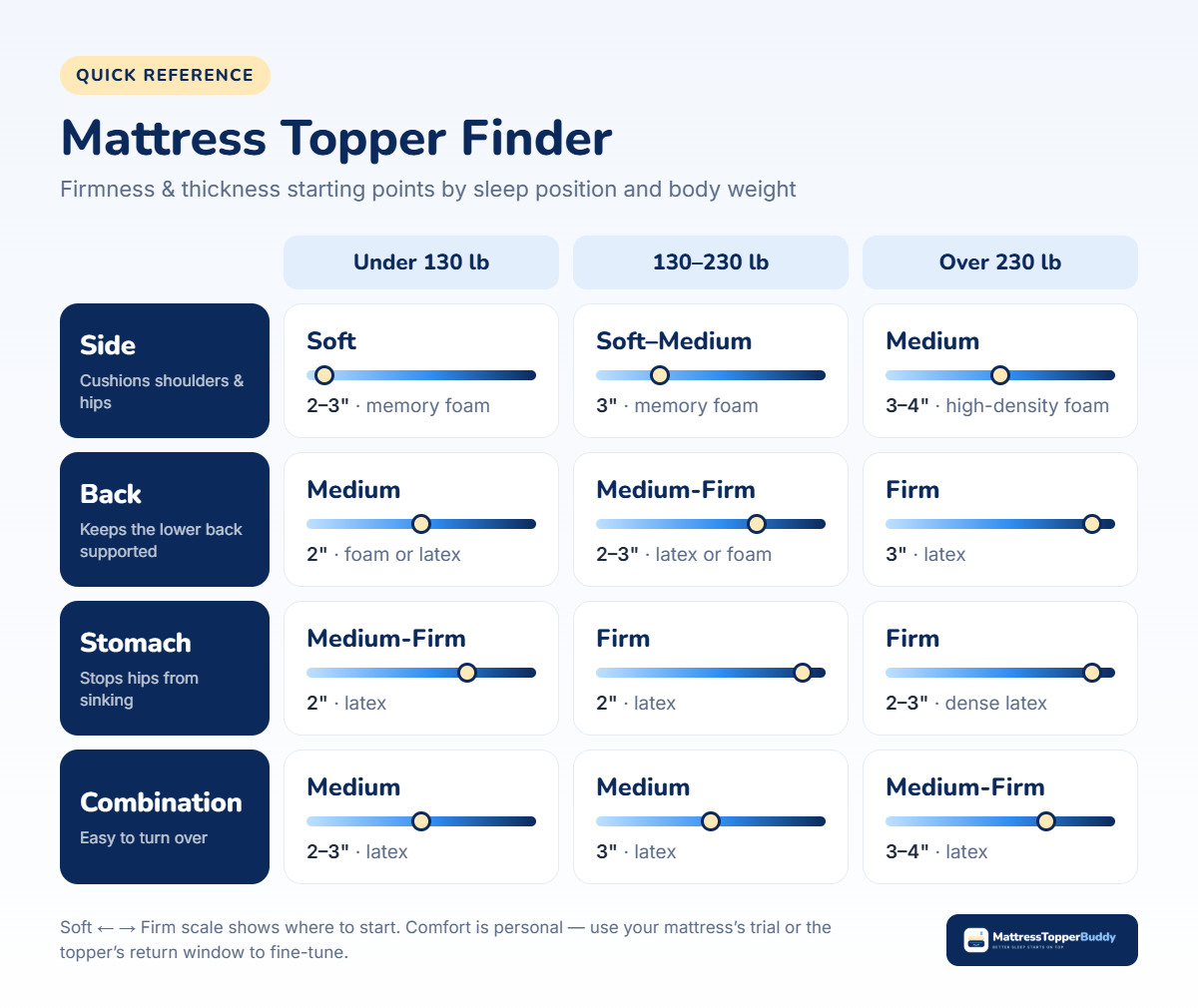
- Side sleepers need the softest surface, so the shoulder and hip can sink in. Soft to medium memory foam, usually 3 inches, works well.
- Back sleepers need the lower back supported. Medium to medium-firm toppers, 2 to 3 inches, are a safe start.
- Stomach sleepers need to keep their hips from dipping. Choose a firm, thin topper (latex is ideal) and avoid plush, thick foam.
- Combination sleepers need something easy to move on. Medium latex is usually the best balance.
Body weight shifts these recommendations. Lighter people (under about 130 lb) don’t compress a topper much, so a firm topper can feel harder to them than the label suggests. Heavier people (over about 230 lb) sink further, so they generally need a firmer, thicker and denser topper to get the same support. Use the chart below as a starting point.
Tip
Firmness labels aren’t standardized. One brand’s “medium” can feel like another’s “firm.” Compare toppers within the same brand when you can, and read what buyers in your weight range say about the feel.
Step 5: Plan for Temperature
If you already sleep warm, a dense memory foam topper can make it worse, because the foam wraps around you and slows airflow. From coolest to warmest, the main materials usually rank like this: wool and latex, then open-cell or gel-infused foam, then fiberfill, then traditional dense memory foam.
Also check the cover. A removable, breathable cover (cotton, Tencel or another lyocell) helps, and it’s easier to keep clean. Treat “cooling” claims as a bonus rather than a guarantee, and pair your topper with breathable sheets if heat is a big issue for you.
Step 6: Check Density, Certifications and Safety
Two foam toppers with the same thickness and firmness can last very different amounts of time. Density, measured in pounds per cubic foot (lb/ft³), is the best clue. As a rule of thumb, memory foam around 3 lb/ft³ is entry-level, while 4–5 lb/ft³ is more durable and resists body impressions longer. Many listings don’t show density; if a brand hides it, that’s worth noting.
Certifications tell you more about what’s in the topper:
- CertiPUR-US® (foam): tested for certain harmful chemicals and for low emissions of volatile organic compounds.
- OEKO-TEX® Standard 100 (textiles and covers): tested for harmful substances.
- GOLS / GOTS (latex / fabrics): certified organic content.
Finally, look for a topper that clearly states it is fiberglass-free. Some budget bedding uses fiberglass as a fire barrier, and it can escape if a cover is unzipped or torn. If a listing doesn’t say, ask the seller before you buy.
Good to know
New foam toppers often have a mild “new product” smell (off-gassing) for a few days. Unroll yours in a well-ventilated room and give it 24–72 hours to fully expand and air out before you put sheets on it.
Step 7: Get the Size and Fit Right
Buy the exact size of your mattress: Twin, Twin XL, Full, Queen, King or California King. Twin XL (common on dorm beds) and California King are longer than their standard cousins, so measure if you’re not sure.
Sliding is the most common complaint about toppers. Look for elastic corner straps, a non-slip bottom, or a fitted cover that wraps around the mattress. Then add the topper’s thickness to your mattress depth and make sure your fitted sheets have deep enough pockets to cover both.
Step 8: Read the Warranty and Return Policy
Comfort is personal, so the return window matters as much as the specs. Some brands offer a sleep trial of 30 to 100 nights; others only accept unopened returns, which isn’t much use for a product you need to sleep on. Check whether you can return a topper that has been unrolled, who pays for return shipping and whether there’s a restocking fee.
Warranties on good foam and latex toppers commonly run 3 to 10 years. Read what counts as a defect: many only cover body impressions deeper than a set amount, such as 1 inch. One more check: adding a topper won’t normally void your mattress warranty, but some mattress warranties require you to use a protector, so keep one under the topper if yours does.
Common Mistakes to Avoid
- Using a topper to fix a sagging mattress. It will sink into the same dip within weeks.
- Going thick and soft as a stomach or back sleeper. Your hips sink and your lower back pays for it.
- Buying on price alone. Low-density foam can flatten within months, so a cheap topper can cost more over time.
- Ignoring the return policy. If you can’t return it after unrolling, you’re betting on a feel you haven’t tried.
- Judging it on night one. Give a new topper at least a week; your body needs time to adjust to a new surface.
Mattress Topper Buying FAQ
What is the best mattress topper type for most people?
A 3-inch medium memory foam topper suits the widest range of sleepers. Choose latex instead if you sleep hot, move around a lot or want more support.
How thick should a mattress topper be?
Three inches works for most people. Go thinner (1–2″) for small adjustments or if you sleep on your stomach, and thicker (4″) for a very firm mattress or if you’re a heavier side sleeper.
Can a mattress topper make a soft bed firmer?
Yes, a firm latex or high-density foam topper can add some support to a slightly soft mattress. It can’t fix a mattress that is sagging or has lost its structure.
How long does a mattress topper last?
Fiber and egg-crate toppers often last 1–3 years, memory foam around 3–5 years, and latex can last 5–10 years or more, depending on density, use and care.
Does a mattress topper go under the fitted sheet?
Yes. The topper sits directly on the mattress (or on a protector), and your fitted sheet goes over both. A topper with its own cover or corner straps will stay in place better.
The Bottom Line
Choosing a mattress topper gets simple once you work through it in order: name the problem, pick the material that solves it, choose a thickness and firmness that fit your body, then check quality, fit and the return policy. Get those right and a topper can be one of the best-value upgrades you’ll ever make to your sleep.
Ready for the next step? Browse our buying guides for picks by sleep position and problem, or see our head-to-head comparisons to settle the memory foam vs latex debate.
This article is for general information only and isn’t medical advice. If you have ongoing back, neck or joint pain, talk to a healthcare professional.